AI in 2026: The Trends That Actually Matter for Your Business
AI in 2026 isn't hype anymore — it's agentic workflows, AI-generated video, and automation running day-to-day business. Here's what's actually changing, backed by the data.
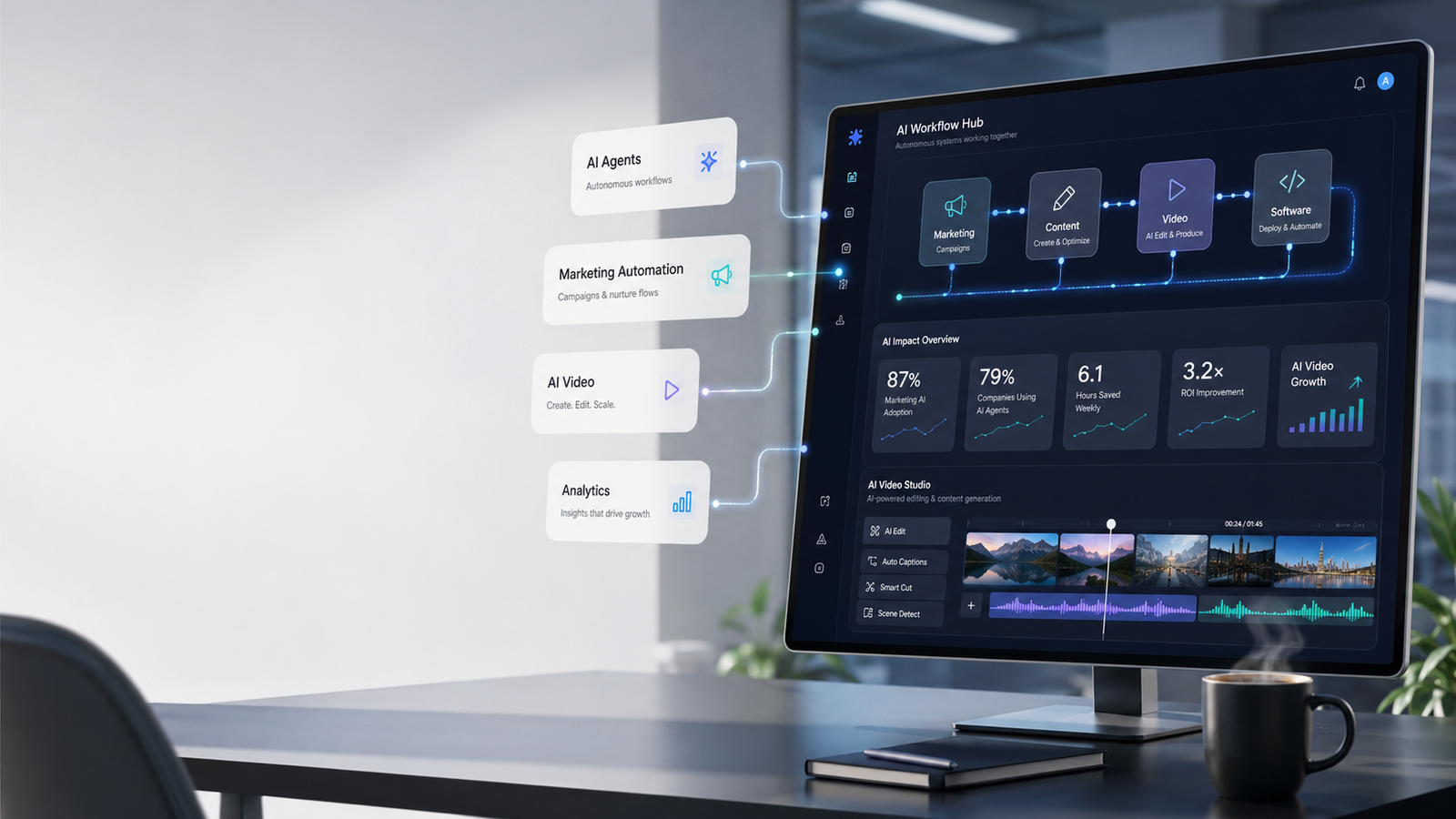
Two years ago, "using AI" mostly meant asking a chatbot for a first draft. In 2026, it means something different: AI agents that run workflows on their own, video content that's AI-assisted from script to final cut, and automation quietly handling the parts of a business that used to eat up someone's whole afternoon.
If you're trying to figure out what's actually worth paying attention to versus what's just noise, here's where things stand, backed by real numbers.
AI agents are doing the work now, not just suggesting it
The shift from "AI as assistant" to "AI as autonomous worker" happened fast. By 2026, roughly 40% of enterprise applications include AI agents, and 79% of companies report agents already in active use inside their organization (Accelirate). On the marketing side specifically, 34% of enterprise marketing teams now run at least one autonomous agent in production — more than double the 14% reported just two quarters earlier (Talkwalker).
The question for most businesses isn't "should we use AI" anymore. It's which parts of the business are still being run manually that don't need to be.
Marketing teams went all in
Generative AI adoption in marketing jumped from 51% of marketers in 2024 to 87% in 2026 (Talkwalker). Copywriting, audience targeting, and campaign analytics lead the pack, with a combined adoption rate around 80%.
The payoff is measurable: AI-assisted content drafting is delivering roughly 3.2x ROI on average, and personalization engines are seeing about 2.7x. On the time side, marketers are recovering an average of 6.1 hours a week, with senior practitioners saving 8–10 hours (Talkwalker).
That's not a marginal efficiency gain — that's most of a workday back, every week.
Video content became an AI-first category
This is the part most businesses are still underestimating. AI video ad spend is projected to hit $9.1 billion globally in 2026, about 12% of all digital video advertising (Vivideo), and 78% of marketing teams now use AI-generated video in at least one campaign per quarter.
UGC-style content — the casual, authentic-feeling videos that don't look like traditional ads — continues to outperform polished production: UGC video ads see roughly 4x higher click-through rates. AI-driven UGC production cuts content creation time by about 50%, reduces cost-per-acquisition by around 30%, and boosts engagement by as much as 8.7x (Hoox). And with 57% of Gen Z consumers preferring short-form video over any other format, the brands producing this kind of content at scale have a real structural advantage.
The governance gap nobody's talking about
Here's the part that doesn't make it into most "AI trends" roundups: over 40% of agentic AI projects are at risk of cancellation by 2027, not because the technology fails, but because of poor governance, no observability, and no real way to track ROI (Accelirate).
In plain terms — a lot of businesses are bolting AI tools onto their existing workflows without a plan for measuring whether any of it is actually working, or who's responsible when it doesn't. That's usually what separates AI initiatives that compound over time from the ones that quietly get abandoned a year in.
What this actually means if you're running a business in 2026
A few things are no longer optional: AI-assisted marketing isn't a competitive edge anymore, it's table stakes. Video content that doesn't incorporate some level of AI-assisted production is going to cost more and move slower than a competitor's. And automation that isn't tied into a broader system — marketing, software, and content all pointed the same direction — tends to underperform automation that is.
That's really the throughline across all of this data: the businesses seeing the biggest returns aren't the ones using the most AI tools. They're the ones treating marketing, software, AI, and content as one connected system instead of a pile of disconnected point solutions.
If you're trying to figure out where to start, that's exactly the conversation worth having.
Let's grab a coffee ☕ — no pitch deck, just a real conversation about where AI actually fits into your business right now.